



She’s not new around here, she was just never counted.
Think of the archetypal sports fan and you still picture a man (replica jersey, beer in hand, bellowing at the ref). The stats have been going against that image for years. Women are about half of the Indian cricket audience, just about half of the NFL audience, the vast majority of the Wimbledon TV audience and three of every four people who have become F1 fans in the past year.
Yet the woman in the stands is still regarded as a visitor. She’s asked to name the offside rule, she’s been accused of being there for a boyfriend or a driver’s jawline and she’s been told her fandom is just a phase. This piece takes her to pieces sport by sport, trait by trait to show what she actually is, what she actually represents in terms of fandom, the influence she already has and why she’s still being laughed at.
How big a share she is
Women are between about 2/5ths and 3/5ths of the participants across the world’s major sports. That is not a minority to be dealt with on the periphery; in many sports it is effectively half the market.
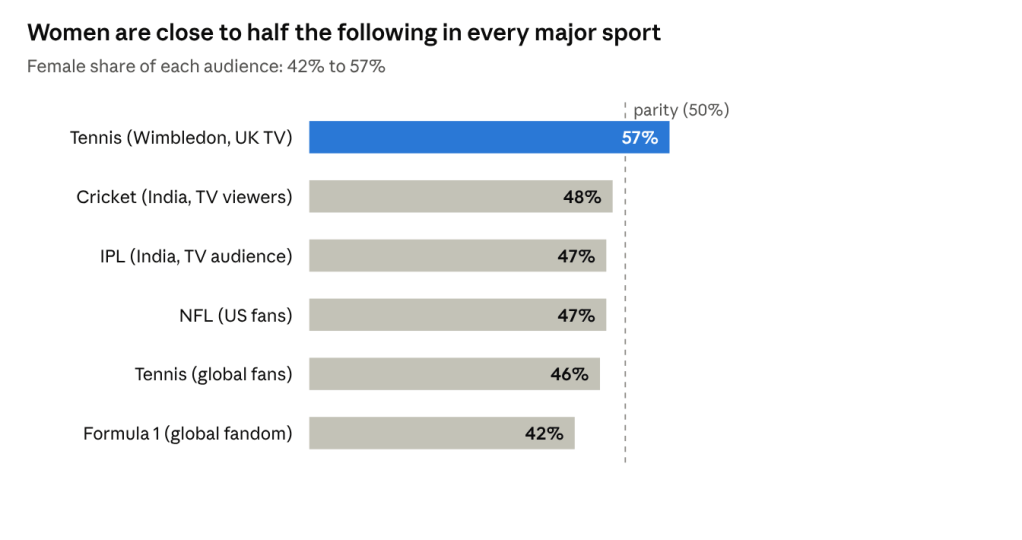
Sources: Women’s Sport Trust (Wimbledon), BARC India (cricket, IPL), NFL (2020), Nielsen (tennis 2025), 2025 Global F1 Fan Survey. The measures vary from source to source.
The figures aren’t the same (one is TV audience, the other is self reported fans), but they point in the same direction. The gap that’s left is not in the number of women who watch at all, but in the number who feel sufficiently welcome to describe themselves as fans.
Sport by sport
The female fan is not one person. She’s a different entity in the paddock, on a stadium terrace and on the living room sofa watching the IPL. She’s bigger than the stereotype.
Motorsport: the fastest-growing fan in the fastest sport
F1 is the most obvious example of a fan base changing gender in real time. The 2025 Global F1 Fan Survey (conducted with Motorsport Network across 100,000+ fans in over 185 countries) found that 74% of fans who started following in the last year were female and overall F1 fandom is now 42% female. Women were 10% of the respondents in 2017, 18% in 2021 and 25% in 2025 (a record high).
She’s young too (nearly half the Gen Z respondents were female). She’d often come through Drive to Survive, YouTube or a friend and then stay for the racing. She’s also pulling the ladder up with her as 42% of female fans follow F1 Academy (the all women junior series) which is their second most followed championship.
Tennis: the one sport where she is already the majority
Tennis has long been the exception that proves the rule. The Women’s Sport Trust’s research found that Wimbledon’s average UK audience is 57% female, making it one of only two sports (the other being the Olympics and Paralympics) to have a higher proportion of female viewers than male. Globally the split is 46% female, 54% male (Nielsen).
The tennis fan is also the most gender blind. In UK surveys 89% of tennis fans watch both the men’s and women’s games and 60% of them watch the women’s game as much as the men’s. She follows the players rather than the flags so a Serena, a Raducanu or an Alcaraz can quite easily move her overnight.
Cricket: half of the world’s biggest sporting audience
In India the female cricket fan is not a niche at all. She is half the market. BARC India data showed women made up 48% of cricket viewers (some 342 million people) and later BARC figures showed women’s share of the IPL TV audience at 47%. That is a larger female audience for one sport than the entire population of most countries.
She watches at home in prime time, the person who ultimately decides what’s on. That said the IPL ad breaks have for years been all about tyres, phones and paan masala (a product which commentators have been pointing out is a complete non-starter). The WPL and the rise of the Indian women’s team have given her actual players to follow in her own image and that has cemented the habit.
American football: the 47% nobody noticed until Taylor Swift
When Taylor Swift started turning up at Chiefs games in 2023 the media headlines treated women attending the NFL as a bit of a novelty. They weren’t. Goodell had actually said in 2020 that 47% of NFL fans are women.
The Swift effect was very real, just often exaggerated. Female viewership went up 9% in the 2023 season (the best figures for women in the league’s history) and male viewership went up by the same 9%. The real difference is in the level of avidity. Men are about twice as likely as women to describe themselves as avid NFL fans and that gap is as much to do with the sense of welcome as it is with any actual level of interest.
Football (soccer): growing in the stands and in her own leagues
Football is the area where the female fan has had to battle most to get a foothold and it’s the area where she is now establishing her own base. In England 37% of club fans now describe themselves as fans of the women’s team too and 2.12m attended women’s games in 2024. At Scottish women’s league games 55% of the crowd are female.
The men’s game still has a male skew in the stands but every generation of growth since the 90s has seen more women filtering through the turnstiles. The 2026 World Cup in North America will be the next test of whether the game treats women as fans or as just a marketing tool.
The anatomy
Get rid of the sport and the same set of characteristics keeps reappearing.
The heart of it is that she follows the people, then the game. Women tend to come in via the story; a driver’s rivalry, a player’s comeback, a team’s documentary. F1’s own CEO has said that the fans are now coming for the stories and then the racing takes hold. That’s not a shallow thing to say at all; that’s precisely how most lifelong attachments to anything are formed.
The eyes: she’s watching everywhere. She’s a massive consumer of highlights, podcasts, YouTube analyses and the like. In F1, 61% of fans are reported to be consuming content every day and that figure jumps to 70% in the Gen Z demographic. Tennis in the UK is pretty much a screen sport with only 6% of fans actually turning up to watch a match.
The voice: she brings others in. Friends and family are by far the biggest route into F1 and absolutely the strongest for women in the 25-34 age group. She’s the one who’ll be arranging the watch party, starting the group chat and dragging a sceptical partner along to the race.
The wallet: she spends and she’s very aware of who’s selling. The female fan will respond to sponsorship and to merchandise and will often be the one to make the household purchases. She still finds the merchandise cut for the male market and the ad breaks that completely ignore her.
The spine: she has to defend it. Unlike the vast majority of male fans she has to prove she belongs. Stacey Pope’s research into female football and rugby fans identified two distinct types: the deeply committed fan whose club is part of their identity and the more casual fan. That’s precisely the same split you’d see in the male fanbase. The difference is that only women are routinely asked to demonstrate their credentials.
Her influence
The female fan is not a growth opportunity for sport any more. She is already one of its load bearing walls.
She moves the ratings. When Swift went to a Chiefs game in September 2023 there was a 63% increase in female viewers 18-47 and NBC reported a 53% increase in viewing among girls 12-17. In Indian prime time the IPL has actually drawn more women than the general entertainment channels which were specifically designed to appeal to women.
She moves money. StubHub ticket sales for the Chiefs went up 175% in three days following Swift’s first appearance and Travis Kelce jersey sales were up 400%. F1’s survey found that 76% of fans said sponsors…
To enhance their experience and to offer luxury, beauty and fashion brands have rushed into the paddocks that once sold nothing but watches and oil.
She creates new leagues. F1 Academy, the Women’s Premier League in cricket, the WSL in England and the NWSL in the US are all examples of leagues which are able to tap into the female fanbase’s desire to support female athletes. She is the reason that a junior women’s racing series is the second most followed championship among female F1 fans.
She changes the culture. Leagues now hire with her in mind. The NFL Women’s Forum (which was born out of the realisation that there were very few women working on game days) is credited with a 141% increase in the number of women in league roles (including coaches). In cricket you have people like Isa Guha and Anjum Chopra who are now regulars in the commentary box. Each of those changes makes the next female fan feel a little bit more at home.
The ridicule
For all her stats and all her influence, the female fan is still the punchline. The jokes are all pretty much the same script.
- “She’s only here for the drivers / players” is the comment of the F1 fan who comes in via Drive to Survive. The hockey fan is told she’s there for the jawlines. Research has repeatedly shown that doesn’t hold water, yet that’s the very first thing they say.
- “Name three players.” The pop quiz. Surveys of female NFL fans showed that 30% had been put to the test in order to prove they were genuine fans, 20% had been labelled a “fake fan” and 60% had had the game ‘mansplained’ to them. You don’t get a man in a jersey at the gate and stop him to ask him about the 1998 squad.
- “She’s here for her boyfriend.” The assumption that a woman’s fandom is a man’s. One NFL podcaster noted that she’s constantly being asked if her dad made her a fan, when in fact the biggest fans in her family were women.
- “She’s ruining it.” That’s the reaction when women arrive en masse (the Swifties in the NFL being the classic example). The backlash is that they’re a distraction. A headline that Swift was “forcing girls to care about football” neatly encapsulated the idea that women can only be there by accident.
- “Girl, explain the offside rule.” The ‘Football 101 for Ladies’ clinic, the pink gear, the commentary that’s just over-explaining. Women have long since moved on from the basics.
Why it persists
The mockery stems from a very narrow conception of what a ‘real’ fan is. The researchers looking at gender and fandom identify the language as being very much gendered with the ‘real’ fan being ‘that guy, the big guy’ and the ‘typical female’ fan being the one who knows less. Some of the women actually internalise this and go on to police other women in order to prove that they are one of the ‘real’ ones.
It persists because of where the gatekeeping occurs. A quarter of female sports fans report experiencing some form of harassment at events (most commonly at NFL games) with 13% saying they’ve felt unsafe. A huge number of them therefore choose to watch from home which in turn makes them appear less committed and reinforces the stereotype. The ‘fake fan’ tag isn’t really a description of women at all. It’s a fee they’re charged to pay in order to get in.
The fan she already is
Take the female sports fan apart, and you find nothing exotic: a heart that attaches to people and stories, eyes on every screen, a voice that recruits others, a wallet that shapes markets, and a spine stiffened by years of proving herself. She is roughly half of cricket’s audience, half of the NFL’s, the majority of Wimbledon’s, and most of Formula 1’s new arrivals.
The sports that grow fastest over the next decade will be the ones that stop asking her to name three players and start asking what she wants. She has been here all along. The only thing that has changed is that the numbers have become too big to laugh off.
Sources
- 2025 Global F1 Fan Survey white paper, Formula 1 and Motorsport Network
- Formula 1 and Motorsport Network unveil 2025 Global Fan Survey, Formula1.com
- 2025 Global F1 Fan Survey summary, Motorsport Network
- Fan engagement in Formula 1: what the 2025 survey tells us, RTR Sports
- Tennis leading the way for female fans, LTA / Women’s Sport Trust
- Serving success: tennis, padel and pickleball, Nielsen
- UK tennis fan survey, Yonder Consulting
- Cricket draws 93% of sports viewers in India, The News Minute (BARC India)
- It’s time for ads directed at women viewers during IPL, SheThePeople (BARC)
- The business upside of Taylor Swift and the NFL, CODE Sports
- The Taylor Swift effect is real, but not as powerful as you think, Boston.com
- Taylor Swift and female sports fans, Awful Announcing
- The NFL in 2023: how influential women are changing the game, Martin Group
- The Taylor Swift effect and the surge in female NFL fans, Scripps News
- Over 1 in 3 fans of English clubs are fans of their women’s teams, Two Circles
- Club Days at Scottish Women’s Football, Manchester Metropolitan / University of Edinburgh
- Are women ‘real’ sports fans?, Stacey Pope, Women in Football
- Studying gender and sports fandom, Pension Plan Puppets


Leave a Reply