
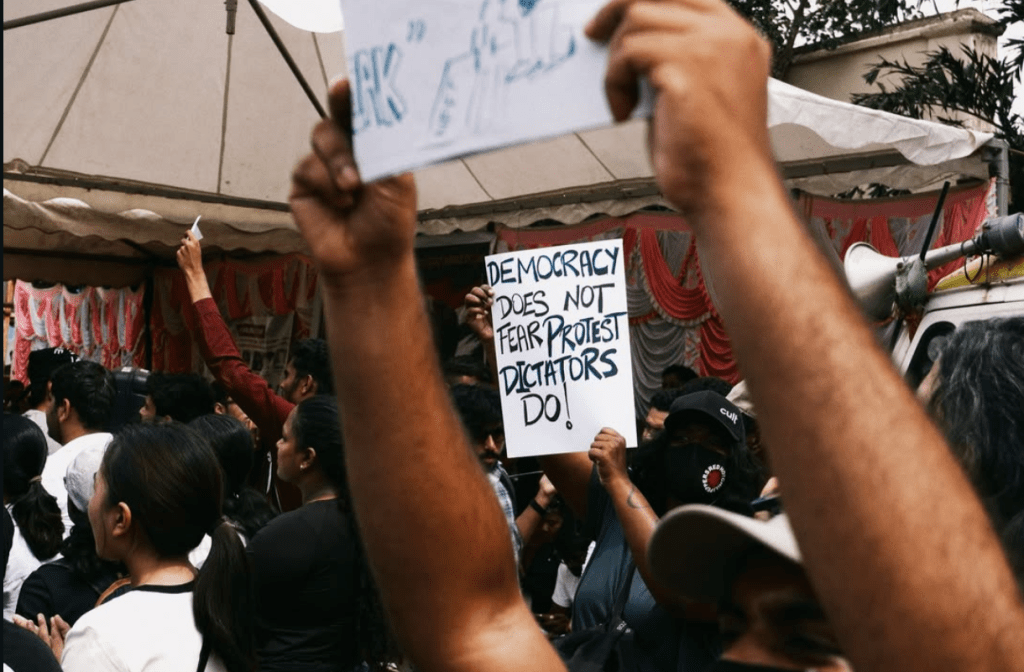
They say nineteen is the age of possibilities. This is the age when all the dreams of childhood ought to have passed into the ambitions of maturity. But when I see tear gas being shot into the streets of Jantar Mantar, when I see water cannons being used against students who only want to be heard, who only have a poster or a book in their hands, I have to come to terms with something very difficult.
Growing up, we were made to feel proud about some particular story associated with our country. We have been raised in a culture that worships knowledge. In schools, our motto was “Knowledge is Power”. Our parents invested their life savings in coaching classes, midnight studies, and practice papers. We were led to believe that India’s best export was its brains—a country that exports engineers, doctors, and scholars.
So, how did a country so well-regarded for its devotion to education turn into this?
How did an education system turn into a gauntlet of broken dreams? We studied until our eyes stung. We thought if we worked hard enough, the system would be fair to us. Instead, we woke up to news of paper leaks, systemic irregularities, and examination boards functioning like black boxes. Years of sacrifice were crushed in a single night, distilled to a deal of who could buy a question paper before dawn.
And what happens when we, the youth, do what any rational generation would do and ask for accountability?
We are met with barricades, lathi charges, and silence.
Which brings me to the biggest lie printed neatly on the opening pages of our Civics textbooks, the proud declaration that India is the “world’s largest democracy”.
Every child in this country can quote the phrase by heart. We wrote it in exam answers, underlined it in blue ink, and repeated it to full marks. But democracy is more than the logistics of having an election every five years. Democracy is an active, daily promise. It is the right to ask the hard questions without being labelled a nuisance, a threat, or, as some people like to say, “anti-nationalist”. It is the promise that the state is for its people, not to insulate itself from them.
When peaceful student protests are met with physical force, when there is no regard for legitimate demands for justice, and when institutions created to secure the future of students work against their interest, it becomes difficult to take the name “world’s largest democracy” seriously. A democracy that fears its own students and chooses not to listen to the voices that will determine its future has failed at its core.
At the age of nineteen, I would like to clarify that holding placards is not my way of scoring points against anyone; rather, I am out here in order to protest against the issue of believing that there is actually no future for us. The protests happening now in the cities are not just about a certain leak or a certain ministry. It is about expressing the disappointment over the lost dream.
We were promised a nation built on merit, justice, and dialogue. Instead, we have a system that demands our quiet compliance while breaking its own rules.
We often hear that young people are the hope of India. So if you want to see India’s future, look beyond what you read in glossy textbooks. Look around at what is happening in the streets. See the majority of students who stand under the sun demanding what they need: fairness, honesty, and government support.
If India ever reaches the level of democracy it claims to be, it would be due to the endeavours of my generation that would not let the promises go in vain.


 Harshee's Lit Lounge
Leave a comment